
WordPress Isn’t Dead. You Just Never Learned It.
Every few months, another “hot take” video shows up telling you WordPress is dying. Dead. Over. Move to Webflow, move to Squarespace, move to whatever the sponsor is this week.
I’m calling it: that’s not analysis, that’s an ad. And it’s wrong.
The numbers don’t lie
WordPress still powers over 40% of the entire internet. Not 40% of “CMS websites” — 40% of every website that exists. Yes, that share dipped slightly this year. A platform running four out of every ten sites on Earth cooling off by a point or two isn’t a death spiral, it’s gravity.
“Hard to use” is a 2015 argument
The loudest complaint is that WordPress is clunky, technical, only for developers. I run my sites on Elementor, and that argument hasn’t been true for years. Drag, drop, publish. My team edits pages together in real time, leaves notes directly on the elements that need changes, and tags each other when something needs a second look — no code, no FTP, no calling in a developer because someone wants to swap a headline.
That’s the part the “dead” crowd conveniently skips: you don’t need to be a tech administrator to be a WordPress editor anymore. If you can use Google Docs, you can run a WordPress site built on Elementor.
Support isn’t optional, it’s the point
The other half of the “WordPress is scary” myth assumes you’re on your own. You’re not, if you set it up right. Expert support exists precisely so a small business owner doesn’t need to become a sysadmin — updates, security, backups, the boring-but-critical stuff, handled, while the team focuses on content.
The real cost of “you’ll always need a developer”
Here’s what the “go build it somewhere else” crowd conveniently skips: hiring a developer for every little change isn’t free, and it isn’t fast. Freelance WordPress developer rates in 2026 swing from about $20–33/hr in Southeast Asia to $47–66/hr in North America, with senior US specialists topping $150/hr for custom plugin or headless work. Eastern Europe and Latin America land in between, roughly $26–45/hr. On top of that, 45% of employers worldwide say they’re struggling to fill web development roles at all — the talent gap is real, and it’s making dev time more expensive, not less.
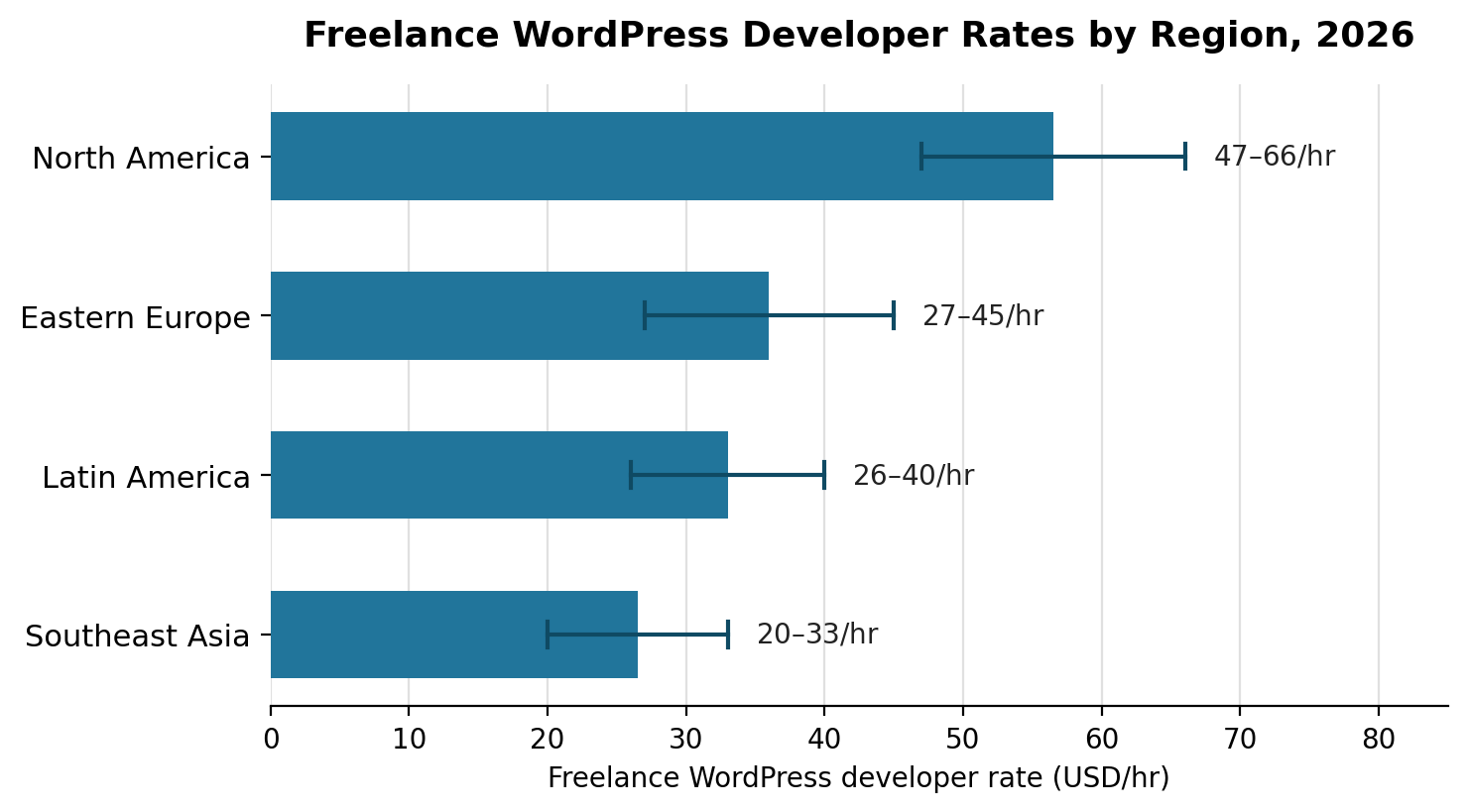
Rates are broad market ranges for experienced freelancers; senior specialists on complex work bill well above these figures. Source: 2026 freelance rate surveys (Arc.dev, Index.dev).
That’s exactly the gap Elementor closes. Every hour you don’t have to pay a developer to fix a typo or swap an image is an hour your budget goes toward growth instead of maintenance. WordPress didn’t get harder to justify — it got cheaper to run.
What’s actually true
WordPress isn’t standing still. There’s active development on collaboration tools, better block editing, AI features with real guardrails — it’s evolving, not decaying. What’s dying is the assumption that “open source and flexible” automatically means “hard and outdated.” That stopped being true once tools like Elementor made real-time team collaboration and no-code editing the default experience.
So next time someone tells you WordPress is dead, ask them when they last actually used it. My guess: not recently.