Uncategorized


The Freelancing Account Takeover Scam: How to Spot It and Stay Safe

If you've been freelancing online for any length of time, you've probably seen the message: "Hey, I can't create an account on Upwork/Fiverr/Freelancer. Can I use yours? I just need to run a few jobs."

Don't. Here's why.

The Scam Explained

This is an account takeover scheme, and it's designed to make someone else's problem become your problem. Here's how it works:

Why They Need Your Account

Scammers ask to use established accounts because:

  • They're already banned. Platforms flag and ban fraudsters. A new account from someone with a history of violations gets shut down fast.
  • Your account has trust. An account with history, ratings, and reviews looks legitimate. Theirs doesn't.
  • Detection avoidance. Fraud detection systems flag suspicious new accounts from unusual locations. Your account bypasses those alarms.

What They Do With It

Once they have access, they:

  • Post their own jobs and take payment from clients, then disappear
  • Scam their clients out of money while your reputation gets damaged
  • Use your account to build false credibility before moving to bigger cons
  • Resell stolen or non-existent work

Your account becomes their launchpad, and you become their liability shield.

The VPN Request

When they ask for VPN access, they're asking for one more layer of cover:

  • Location masking. It makes the fraudulent activity appear to come from your location, not theirs
  • Plausible deniability. When platforms investigate, they can claim you committed the fraud, not them
  • Harder to trace. It complicates the platform's ability to link the scam back to their real identity

Why You're the One Who Gets Burned

This is the critical part: when things go wrong, you're liable, not them.

Platform Consequences

  • Your account gets suspended or permanently banned
  • Your ratings and history vanish
  • You're flagged as a fraud risk on that platform
  • Other platforms may ban you for "related accounts"

Legal Consequences

  • If money's involved, you could be liable for chargebacks
  • You might be blamed for the scam, not them
  • You're the one with a paper trail to your real identity

Professional Consequences

  • Your freelancing reputation is destroyed
  • New platforms will see your ban history
  • Clients who hired you before may question past work

They walk away clean. You're left explaining fraud you didn't commit.

Red Flags

Watch for these warning signs:

  • Can't create their own account. Legitimate reason? There isn't one.
  • Pushing for quick access. Real work can wait for them to set up properly.
  • Vague about why they need it. If they can't explain clearly, that's a sign.
  • New to the platform. Most scammers start asking favors immediately.
  • Asking for email/password access or VPN. These requests are only for takeover schemes.
  • Too casual about "just running a few jobs." This phrasing is classic.

What To Do Instead

If Someone Asks

  • Politely decline. "I can't let anyone access my account."
  • Don't over-explain. You don't owe a detailed reason.
  • Block them. Many scammers try multiple people.

If You're Tempted Because They Seem Legit

  • They're not. Legitimate freelancers create their own accounts.
  • The fact that they can't create one is a massive red flag.
  • No amount of money is worth your reputation.

If You've Already Shared Access

  • Change your password immediately
  • Enable two-factor authentication
  • Monitor your account for unauthorized activity
  • Contact platform support to report suspicious access
  • Document everything

The Bottom Line

Freelancing platforms exist so people can build their own legitimate presence. When someone asks to use yours, they're asking to use your reputation as a disguise for fraud. The moment you give them access, you become responsible for everything they do under your name.

It's not worth it. Not for a quick job, not for money, not for being helpful. Your account is your professional asset—protect it like you'd protect your Social Security number.

If they can't create an account, that's their problem to solve. And if they won't solve it the legitimate way, that tells you everything you need to know about what they're actually planning to do.

Stay safe out there.

Uncategorized

We Don’t Outsource Our Code—Period

We Don't Outsource Our Code—Period

Why keeping your code in-house is a security decision, not just an operational one.

Security lock icon with code in background

There's a pervasive assumption in modern business that outsourcing is the path to efficiency. Hand off non-core work to specialists, scale faster, reduce overhead. It sounds logical on a spreadsheet.

We don't do it. We don't outsource our code, our projects, or our security architecture—not overseas, not to contractors, not to anyone. And we're not alone in taking this stance.

Here's why: outsourcing your code isn't just an operational decision. It's a security decision. And we treat it like one.

The Real Risk of Outsourcing Code

Most companies that outsource focus on the visible savings: labor cost differential, reduced payroll tax burden. But they're gambling with something worth far more than they're saving.

When you outsource your code, you're handing over your crown jewels. You're giving external teams access to your security protocols, your architecture decisions, your competitive advantages. Your code is a roadmap to how you work.

In the wrong hands—or just in careless hands—it can be reverse engineered, copied, or exploited.

Think about what lives in your codebase: authentication mechanisms, payment processing logic, data handling procedures, third-party integrations, the logic that makes you different from your competitors. All of it now exists on someone else's servers, in someone else's version control, accessible to people you don't employ and can't control.

Code document illustration

There's also the knowledge problem. The reasoning behind your security decisions lives in your codebase. When someone outside your organization has access to it, they understand your vulnerabilities. They know where you cut corners. They know what you're protecting and how. That's not just a quality risk—it's a security risk.

And outsourced teams have misaligned incentives on security. They're incentivized to move fast and hit your requirements. They're not incentivized to prioritize your security posture, to think three steps ahead about potential exploits, or to invest in long-term architectural integrity. If there's a shortcut that works, they take it. Someone else's problem, not theirs.

The money you save on outsourcing disappears fast when you're managing security incidents, patching vulnerabilities, or recovering from competitive damage.

The Advantage of Ownership

When you keep your code in-house, you keep control. That's not theoretical. That's everything.

Your security architecture stays yours. Your engineers understand every decision that went into it. They own the vulnerabilities. They own the fixes. They own what happens when something breaks at 2am. That accountability changes everything about how code gets written.

It also gives you speed. There's no handoff. No waiting for bandwidth on someone else's roadmap. A security issue gets identified and patched the same day. A vulnerability gets closed before it can be exploited. When you own it end-to-end, you move fast.

The biggest advantage is knowledge retention and control. The people who built your product still work here. They remember why security decisions were made the way they were. They understand the architecture deeply enough to evolve it safely. This compounds over years—your codebase gets more secure, not less, because the people maintaining it understand every corner.

And crucially: your code never leaves. Your IP never leaves. Your competitive advantage never leaves.

Team collaborating with servers in background

Tools Amplify Your Team—Outsourcing Replaces Them

Here's the distinction people often miss: using tools is the opposite of outsourcing.

Outsourcing means "we hired someone else to do this." Using tools means "we equipped our team to do this better."

We use AI assistants, frameworks, libraries, platforms, data services. Claude helps draft faster. Figma handles design collaboration. We use hosted databases. None of that is outsourcing. Your team still writes the code. Your team still makes the security decisions. Your team still owns the outcome.

Tools stay inside your firewall—or they stay under your control even if they're cloud-based. Your code stays in-house. Your IP stays in-house. Your team's understanding of every decision stays in-house.

When you outsource, you lose control. You hand off execution, judgment, and ownership to people outside your organization. Your code leaves. Your security protocols leave. Your competitive secrets become accessible to people you don't employ.

When you use tools, your team gets stronger, faster, smarter. But they stay yours. The locus of control never shifts.

The Line We Won't Cross

We don't outsource code. We don't outsource projects. We don't outsource security or architecture decisions. That's not negotiable.

Are there edge cases where external expertise makes sense? Yes. But there's a clear line: if it touches your code, your security, your product—it stays in-house. You might bring in a consultant to review architecture, but they review it, they don't build it. You might hire an external firm for a security audit, but they audit your code—they don't write it.

Most companies get this wrong. They outsource first and only pull work back in-house after they've had a breach, lost IP, or realized their contractor's code was garbage. We've decided not to learn that lesson the hard way.

Warning sign representing firm boundaries

This Is How You Protect Your Assets

There's a reason we're direct about this: outsourcing code is a security decision disguised as an operational one.

When your code is overseas, it's accessible. When it's in contractors' repositories, it's vulnerable. When people outside your organization understand your architecture, they understand your weak points. Reverse engineering your product becomes possible. Your security protocols become known. Your competitive advantage leaks.

Some companies get hacked and then realize too late that the vulnerability came from outsourced code they never fully understood. Some lose IP to contractors who copy and resell. Some find that their security is weaker than they thought because external teams cut corners they didn't catch.

We don't take that risk. We keep our code. We keep our IP. We keep our security posture under our control.

The Line in the Sand

This isn't a preference. It's a principle.

Your code is your competitive advantage. Your security architecture is your liability if it's wrong. Your product decisions compound over years only if the people making them understand the full history and context. None of that should ever be outsourced.

We use tools to make our team stronger. We hire expertise to make our decisions better. But we keep the work in-house. We keep the code in-house. We keep the control.

That's the stance we've taken. And if your business is serious about security, ownership, and long-term competitive advantage, it's the stance you should take too.

Uncategorized

When the Safety Net Has Accessibility Holes

When the Safety Net Has Accessibility Holes: My Three-Hour Hold With Unemployment

I called unemployment benefits last week. I waited three hours on hold. The call dropped twice.

I mention this because I have a disability, and that three-hour hold wasn't just inconvenient—it was a barrier the law explicitly says shouldn't be there.

What Happened

The first call: I got through after 90 minutes. The representative said they'd transferred me to the right department. The call dropped before the transfer went through.

Second call: Another 45 minutes waiting. This time I made it to an agent, got a case number, and was told I'd need to call back with more documentation.

Third call: Two more hours waiting, only to be told I should have submitted something online that the website said required a phone call.

I could have paid someone to call for me. I could have forced myself through the exhaustion that comes after holding a phone to my ear for hours while managing my symptoms. Or I could do what I did: spend a week gathering energy to try again, knowing the next attempt might be exactly the same.

For people managing disabilities—chronic pain, hearing disabilities, cognitive disabilities, psychiatric disabilities—three-hour hold times aren't just frustrating. They're disqualifying. They make the difference between getting benefits and giving up.

The Law Is Clear

The Americans with Disabilities Act doesn't allow government agencies to hide behind "high call volume." It requires effective communication access as a fundamental right.

Under the ADA, unemployment offices must provide:

  • Alternatives to phone-based access (online portals, email, in-person services)
  • Callback systems so disabled people aren't forced to hold indefinitely
  • Accessible communication for deaf, blind, and hard-of-hearing callers
  • Accommodations for people who can't manage long phone calls due to disability

What they shouldn't do: Make accessibility an afterthought while the system crumbles for everyone, disabled or not.

This Is a Choice, Not an Accident

I'm not arguing that unemployment offices are underfunded. They are. I'm not ignoring that staffing is stretched. It is. But those are reasons to fund them properly, not reasons to let accessibility requirements slide.

The ADA has been law for over 30 years. Callback systems exist. Online intake exists. States that have implemented these systems report they reduce call volume because people aren't calling back repeatedly after being dropped.

The current system isn't just inaccessible to disabled people. It's broken for everyone. The difference is: everyone else can eventually push through a bad experience. Disabled people often can't. The barriers don't just inconvenience us—they exclude us from benefits we've earned and need to survive.

What Needs to Change

To the unemployment office administrators and policymakers reading this:

You're required by law to fix this. Not eventually. Now.

Specifically:

  • Implement callback systems immediately. If you can't answer calls within 15 minutes, you need to offer callbacks. This is standard practice in private customer service.
  • Develop accessible online alternatives for intake, document submission, and status checks. Not everything needs to be a phone call.
  • Hire enough staff to actually answer calls without three-hour waits. If your budget doesn't allow this, that's a budget problem, not an accessibility problem.
  • Create a disability accommodation request process that's actually advertised and accessible—so people know they can ask for alternatives.
  • Measure accessibility. Track hold times, call completion rates, and how many people give up. Use that data to drive improvements.

This Isn't Theoretical

For me, that week of failed calls meant I couldn't focus on other responsibilities. I was in pain from holding a phone. I was frustrated. I felt like the system didn't see me or care that I was trying to access something I was entitled to.

I have resources many people don't—time, support, education. I got through eventually. But I shouldn't have had to fight that hard for a system that's legally required to be accessible.

Thousands of people with disabilities are facing this same choice right now: exhaust themselves trying to reach unemployment, or go without the help they need.

Fixing this isn't charity. It's the law. And more importantly, it's the baseline for a system that actually works for everyone.

⚖️
Uncategorized

Spiraling-Songbook

🌀

SPIRALING

The new album from Solar Blu — 12 all-original tracks, 48 minutes, out everywhere now.

Listen to Spiraling 🎧

A Storybook, On Us 📖

To celebrate the release of Spiraling, we made you something to keep:
a storybook to read while you listen. Flip through it below, or download
the PDF and take it with you. Free, always.

Your browser can't display the PDF here — no problem.Download the Storybook


Uncategorized

The VM Update That Almost Ended Me (and Then I Made 10 Cold Calls Anyway)


The VM Update That Almost Ended Me (and Then I Made 10 Cold Calls Anyway)

SolarBluSeth · Monday recap

Running a one-man web shop means there’s no “not my department.” Today was a perfect example — and yeah, it’s Monday, so of course it started like this.

Part 1: The Nightmare

Woke up (or never really went to sleep, depending on how you count it) to find one of my machines in a full-blown virtual machine update nightmare. You know the kind — everything was fine yesterday, you let an update run, and suddenly you’re staring at a VM that won’t cooperate and a sinking feeling that today’s plans just got hijacked.

The actual culprit this time? An old Visual Basic script that needed updating to play nice again. Anyone who’s kept a business running for 30 years knows exactly what this is like — there’s always some quietly load-bearing piece of legacy code sitting in the corner, doing its job for years, until an update comes along and reminds you it’s still there.

So that was the morning: digging back into old VB code, figuring out what broke, patching it up, and getting the machine back on its feet.

Part 2: Then I Just… Went to Work

Here’s the thing about running your own shop — you don’t get a day off just because your morning turned into a computer crisis. So once the machine was breathing again, I pivoted straight into lead gen mode: 10 cold calls to potential new clients.

No fanfare, no big production. Just picked up the phone and started dialing after wrestling a VM back to life. That’s the actual job — not glamorous, but that’s how SolarBlu keeps moving.

The Monday Tax

Only Monday, and already a full VM crisis plus a round of cold calls. If this is the opening act, the rest of the week better be paying attention.

The Takeaway

Some days are “fix the ancient script that’s holding everything together” days. Some days are “get on the phone and find new business” days. Today was both, back to back, no break in between. That’s freelance web life — you’re sysadmin, developer, and salesperson before lunch, and nobody’s coming to save you if the VM doesn’t boot.

Tomorrow it’ll probably be something else entirely. That’s kind of the fun of it.


Uncategorized

WordPress Isn’t Dead. You Just Never Learned It.

WordPress Isn’t Dead. You Just Never Learned It.

Every few months, another “hot take” video shows up telling you WordPress is dying. Dead. Over. Move to Webflow, move to Squarespace, move to whatever the sponsor is this week.

I’m calling it: that’s not analysis, that’s an ad. And it’s wrong.

The numbers don’t lie

WordPress still powers over 40% of the entire internet. Not 40% of “CMS websites” — 40% of every website that exists. Yes, that share dipped slightly this year. A platform running four out of every ten sites on Earth cooling off by a point or two isn’t a death spiral, it’s gravity.

“Hard to use” is a 2015 argument

The loudest complaint is that WordPress is clunky, technical, only for developers. I run my sites on Elementor, and that argument hasn’t been true for years. Drag, drop, publish. My team edits pages together in real time, leaves notes directly on the elements that need changes, and tags each other when something needs a second look — no code, no FTP, no calling in a developer because someone wants to swap a headline.

That’s the part the “dead” crowd conveniently skips: you don’t need to be a tech administrator to be a WordPress editor anymore. If you can use Google Docs, you can run a WordPress site built on Elementor.

Support isn’t optional, it’s the point

The other half of the “WordPress is scary” myth assumes you’re on your own. You’re not, if you set it up right. Expert support exists precisely so a small business owner doesn’t need to become a sysadmin — updates, security, backups, the boring-but-critical stuff, handled, while the team focuses on content.

The real cost of “you’ll always need a developer”

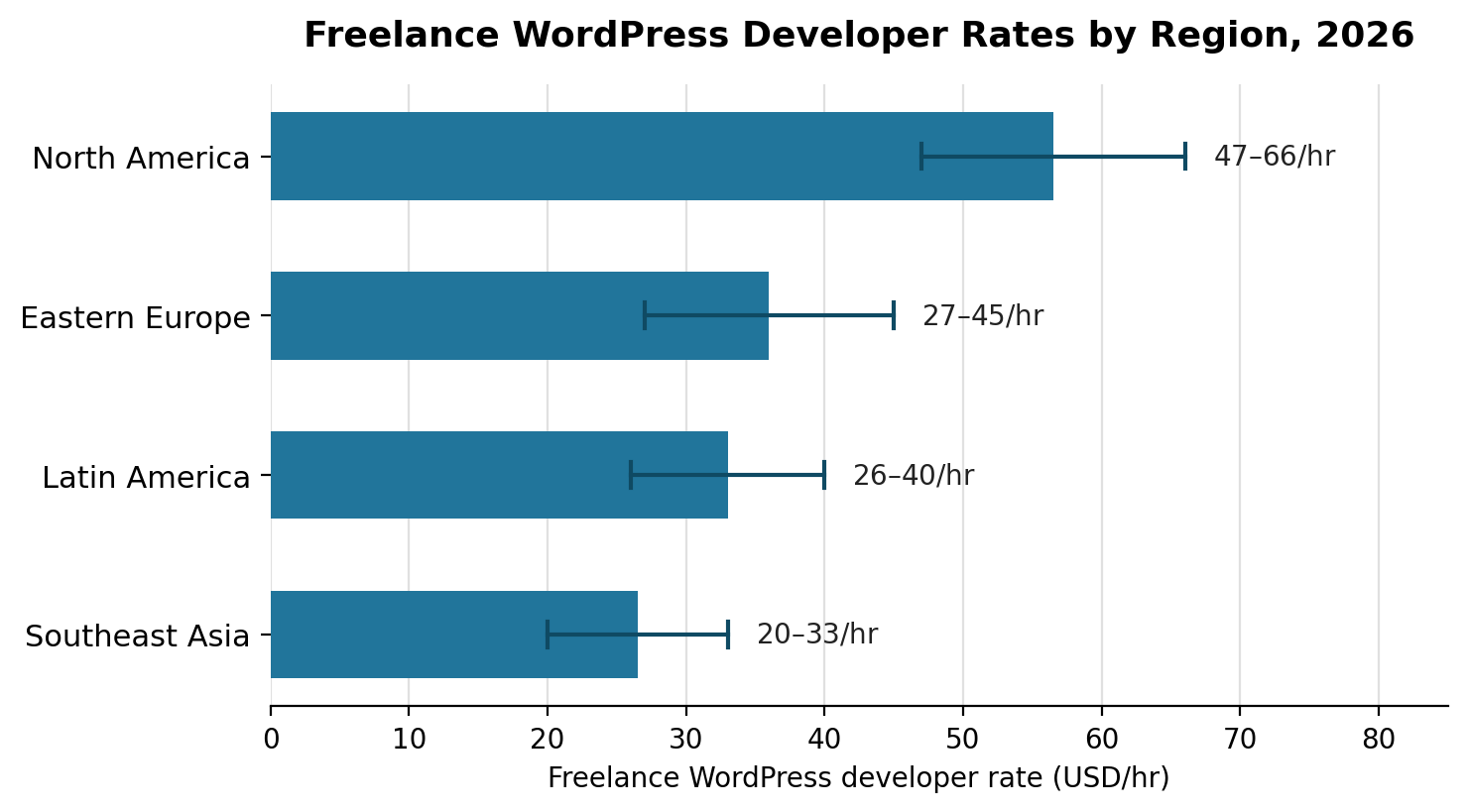
Here’s what the “go build it somewhere else” crowd conveniently skips: hiring a developer for every little change isn’t free, and it isn’t fast. Freelance WordPress developer rates in 2026 swing from about $20–33/hr in Southeast Asia to $47–66/hr in North America, with senior US specialists topping $150/hr for custom plugin or headless work. Eastern Europe and Latin America land in between, roughly $26–45/hr. On top of that, 45% of employers worldwide say they’re struggling to fill web development roles at all — the talent gap is real, and it’s making dev time more expensive, not less.

Bar chart of freelance WordPress developer rates by region in 2026

Rates are broad market ranges for experienced freelancers; senior specialists on complex work bill well above these figures. Source: 2026 freelance rate surveys (Arc.dev, Index.dev).

That’s exactly the gap Elementor closes. Every hour you don’t have to pay a developer to fix a typo or swap an image is an hour your budget goes toward growth instead of maintenance. WordPress didn’t get harder to justify — it got cheaper to run.

What’s actually true

WordPress isn’t standing still. There’s active development on collaboration tools, better block editing, AI features with real guardrails — it’s evolving, not decaying. What’s dying is the assumption that “open source and flexible” automatically means “hard and outdated.” That stopped being true once tools like Elementor made real-time team collaboration and no-code editing the default experience.

So next time someone tells you WordPress is dead, ask them when they last actually used it. My guess: not recently.

Uncategorized

If You’re Spending $5K on Facebook Ads, a Typo Isn’t Cosmetic ; It’s an Accountability Problem

If You’re Spending $5K on Facebook Ads, a Typo Isn’t Cosmetic – It’s an Accountability Problem

There’s a wave of ad creative right now that’s obviously AI-generated and unedited: awkward phrasing, misspellings, copy that reads like a first draft nobody looked at twice. It’s easy to blame the tool. The tool isn’t the problem. Somebody was handed a $5,000 budget, generated the copy, and shipped it without anyone checking the work. That’s not an AI problem — that’s nobody being held to a standard.

The Tool Didn’t Skip the Proofread, a Person Did

AI copy generation is a legitimate way to produce drafts fast. That’s what it’s for. The failure isn’t that the draft had errors — early drafts always have errors, that’s what makes them drafts. The failure is that whoever ran the campaign treated the output as finished work instead of a first pass that still needed a human to check it. Somewhere in that process, either nobody owned “review before launch” as part of the job, or somebody owned it and didn’t do it. Either way, that’s a standards gap, not a technology gap.

What This Looks Like When Accountability Actually Exists

In a shop with real standards, AI-generated ad copy doesn’t go live raw. Someone reads it out loud before launch, checks spelling, confirms the offer makes sense, confirms it matches the brand’s voice — and that step isn’t optional or dependent on whether someone “gets around to it.” It’s built into the process the same way a final review is built into any other deliverable that costs money if it’s wrong. When that step is missing, it’s usually because nobody defined it as part of anyone’s job, or because it was defined and nobody enforced it.

Why This Keeps Happening

It’s happening at scale right now because AI makes it possible to generate huge volumes of ad variations with almost no effort, and that volume creates an illusion of productivity. Producing twenty ad variants in five minutes feels like progress. But volume without a review step doesn’t produce twenty good ads — it produces the same uncaught mistake copied twenty times. The tool made the output faster. It didn’t make anyone more accountable for what went out the door.

The Money Is Just Where the Failure Becomes Visible

The cost is real — sloppy, error-riddled ads get lower engagement, and Meta’s delivery system charges more per result for ads that underperform, so the mistake does show up on the invoice. But the invoice is a symptom, not the root cause. A team that lets typo-ridden copy go live on a $5,000 campaign would very likely let the same thing slide on a client deliverable, an internal report, or a product page — the ad spend just happens to be where the lack of a review standard becomes expensive enough to notice.

The Fix Isn’t a Better Tool

It’s a defined, enforced step: nothing generated by AI ships without a specific person reading it and signing off before it goes live. That’s not a technology upgrade. It’s a management decision — deciding that “good enough to launch” requires a human check, and then actually holding whoever owns that step to it. Skip that decision, and it doesn’t matter how good the AI gets. The next mistake just gets generated faster.

Uncategorized

What Freelancers Should Actually Charge in 2026 (And Why Bid Sites Are Racing You to the Bottom)

What Freelancers Should Actually Charge in 2026 (And Why Bid Sites Are Racing You to the Bottom)

If you’ve spent any time bidding on Upwork or Freelancer.com, you already know the pattern: you quote a fair rate for real, skilled work, and someone underbids you by 50% within the hour. It’s easy to start thinking that’s just what the market pays. It isn’t. It’s what a specific slice of the market — clients hunting for the cheapest possible bid — pays. The rest of the market, the one paying actual professional rates, is mostly invisible on the first page of open jobs.

Here’s what the data actually says, and how to price yourself against it instead of against the bottom of a bid list.

The National Numbers

For WordPress work specifically, freelance rates break down roughly like this:

  • Entry-level: $15–40/hr
  • Mid-level: $40–80/hr (averaging around $73/hr)
  • Senior / specialized (custom plugin work, WooCommerce, security hardening): $80–150+/hr, averaging around $128/hr

Specialized skills carry a real premium — security hardening and WooCommerce work typically add 15–40% on top of a base rate, because fewer people can do them reliably.

For general freelance web development, the U.S. median sits closer to $85/hr, with experienced developers commonly billing $95–160/hr.

New York and Chicago

Location shouldn’t gate what you charge a U.S.-based client, but it’s useful context for anchoring an ask:

  • New York: averages around $46/hr broadly, but experienced or specialized developers in that market routinely bill $85–150+/hr.
  • Chicago: averages around $45/hr.

If a client is based in a major U.S. metro, there’s no reason to default to a global-average rate just because the job is posted on a platform with a lot of $10/hr bids sitting next to yours. The client’s budget reality and the platform’s visible bid range are two different things.

The Formula for Setting Your Own Rate

Most freelancers underprice because they calculate rate backward from “what sounds competitive” instead of forward from what they actually need to earn. The standard formula:

Hourly rate = (Target take-home income + business expenses) ÷ ((1 − tax rate) × billable hours)

A few things people consistently forget when running this math:

  • Billable hours are lower than you think. Most freelancers only bill 60% of their working time — the rest goes to admin, proposals, and client management. If you work 40 hours a week, that’s realistically 20–25 billable hours.
  • Self-employment tax is separate from income tax. As a freelancer you pay both the employee and employer halves of Social Security and Medicare — an extra 15.3% on top of federal and state income tax that a salaried job would split with an employer.
  • “Competitive” bids on low-budget platforms are often not sustainable rates — they’re rates set by people who haven’t run this math, or who are pricing for a different cost of living entirely.

Run the numbers with your real expenses and tax bracket, and $22/hr is very likely below what the math says you need — not just below what the market says you’re worth.

Why the Bid Platforms Skew Low

Upwork, Freelancer.com, and similar bid-based marketplaces are structurally built for downward pressure: dozens to hundreds of freelancers competing for a single posted budget, often set by a client with no real sense of what the work costs. That’s a very different pool than the client base hiring through referrals, agencies, or platforms like Fiverr, where you set the price and buyers come to you instead of underbidding each other for your attention.

None of that means bid platforms are useless — they’re a real source of work and relationship-building. It means treating every low-budget listing as “the market rate” is a mistake. The actual market rate is closer to $40–80/hr for solid mid-level WordPress work, $85–150+/hr for specialized or metro-market clients, and it’s worth pricing toward that number rather than toward whatever the lowest bid in the queue happens to be.

The Practical Takeaway

  • Calculate your real rate using the formula above before you look at any job board.
  • Treat platform bid ranges as one data point, not the ceiling.
  • Reserve the rock-bottom-budget jobs for cases where your own technique or automation makes the work fast enough that the low rate still nets out fine per hour.
  • When a U.S. client is on the other end, it’s reasonable to quote toward U.S. mid-market rates, regardless of what other bidders on the same listing are asking.

Underpricing doesn’t just cost you money on one job — it resets the baseline a client expects to pay you on every job after it. Charge like the professional you are, and let the clients who can’t meet that number self-select out.

Uncategorized

From Solo Grind to Global Outsource

From Solo Grind to Global Outsource

Building a Sustainable International Practice

The thing about freelancing is nobody tells you the real story.

They show you the Instagram posts about “digital nomad life” and “work from anywhere.” What they don’t show you is the 3 AM panic when a client goes silent. The month you land three projects and then six months with nothing. The slow realization that trading hours for money doesn’t scale—it just exhausts you.

I spent 30 years building websites. Thousands of them. I learned WordPress before it was cool. I built proprietary frameworks. I managed teams. I watched the web evolve from static HTML to full-blown applications. And somewhere along the way, I realized I was still grinding the same way I started: one project at a time, always hunting for the next client.

Then something shifted.

The Problem with “Do Everything Yourself”

For decades, I operated the traditional freelancer playbook:

  • Build a portfolio
  • Pitch clients relentlessly
  • Win projects
  • Deliver work
  • Hunt for the next thing
  • Repeat

It’s exhausting. And the worst part? You’re completely replaceable. Anyone can build a WordPress site with Elementor. Your only leverage is price or availability.

I started noticing patterns in the clients who stuck around. They weren’t the cheapest projects or the biggest budgets. They were the ones where I built something proprietary—frameworks and tools they couldn’t get anywhere else. Advanced Themer was one of those. It became part of their workflow. They couldn’t just hire someone else and replicate it.

Those clients? They kept coming back.

The Recruiter Partnership Changed Everything

Instead of chasing every opportunity, I started thinking differently: What if someone else did the sourcing?

Enter the recruiter model. Instead of spending 40% of my time on sales calls and vetting tire-kickers, a recruiter finds clients, vets them, and brings the good ones to me. They take a small percentage. I focus on delivery.

The beautiful part? Those clients started being international—EU and Australia mostly. Clients I never would have found on my own.

And here’s the thing about international clients: they value reliability over proximity. They don’t care that you’re in a different timezone if you deliver consistent, quality work. They care that you understand their business and that they can depend on you.

From Projects to Partnerships

Once the recruiter started bringing EU and AU clients, something interesting happened.

Instead of one-off projects that ended and required hunting again, I started landing clients who wanted ongoing support. Monthly retainers. Standing relationships. They’d come back because:

1. The work is solid

30 years of experience means I know what actually works

2. The proprietary tools matter

Advanced Themer isn’t something they can replicate with a new freelancer

3. The relationship is built

When you deliver consistently across timezones and manage expectations, clients trust you

Suddenly I wasn’t a freelancer hunting for gigs. I was an outsource partner in a global supply chain. The recruiter sources clients. I deliver. The client gets reliable, skilled work. Everyone wins.

Why This Model Actually Works

Here’s what most freelancers don’t understand about recurring revenue:

It’s not about the money (though that’s nice). It’s about predictability.

You know what’s coming next month. You can plan. You can breathe. You’re not constantly in survival mode.

And when you build with proprietary tools—frameworks that are yours—you create a moat. A client can’t just replace you with whoever undercuts your price. You’re embedded in their workflow.

International clients get this immediately. They’ve worked with cheap outsources who disappeared. They’ve dealt with quality issues and communication gaps. When they find someone who delivers consistently, speaks their language (literally and professionally), and has built something special into their site—they hold on tight.

The Real Advantage

The traditional freelancer game rewards volume: hustle more, pitch more, win more. Burn out faster.

The partnership model rewards reliability: show up consistently, deliver excellent work, build relationships that last.

One scales by burning out. The other scales by becoming more valuable.

Your clients don’t want another freelancer. They want a partner who understands their business, delivers work they can depend on, and uses tools and frameworks that actually solve their problems. That’s worth paying for. That’s worth keeping around.

Building Your Own Edge

If you’re reading this as a freelancer, here’s the real talk:

You can compete on price. Thousands of people will undercut you.

You can compete on availability. Someone’s always hungry.

Or you can build something proprietary. A framework. A process. A reputation for reliability that crosses borders.

Then find partners (recruiters, agencies, networks) who can bring you clients who value that edge.

You’ll never have to hustle the same way again.

The web has changed a lot in 30 years. But the fundamentals are the same: build things people can’t build without you. Deliver consistently. Show up across timezones. Let the relationships compound.

That’s not a hustle. That’s a practice.

Want to Build a Sustainable International Web Practice?

Let’s talk about how proprietary tools and strategic partnerships can transform your freelance career.


Get In Touch →

Uncategorized

spiral


Spiral cover art

Spiral — An Original Story
Baby in basket on the river from the Emerald City

Chapter One — Sent From the Emerald City
Boy growing up on the farm collage

Chapter Two — The Farm Years
Boy finds glowing emerald key in chicken coop

Chapter Three — The Key in the Chicken Coop
Boy at the magic tree in the dark forest

Chapter Four — The Magic Tree
Alice and the boy on the yellow brick road

Chapter Five — The Yellow Brick Road


Solarbluseth — An Original Story

Spiral

Follow the road. Face the darkness. Find your way home.


Chapter One

Sent From the Emerald City

Before the boy ever walked a farm road or heard a rooster crow, he floated. A tiny baby in a wicker basket, wrapped in soft light, carried by a river that wound through a land he would not remember — not yet.

The Emerald City glowed behind him. Something had gone wrong there. Something had sent him away. The river carried him toward a swirling vortex, and on the other side — the amber glow of a city called Chicago, flickering with lightning.

The human world received him without fanfare. A farm. A family. A new life.

A baby in a wicker basket floats down a glowing river from the Emerald City toward a vortex portal over Chicago


Chapter Two

The Farm Years

He grew up the way farm boys do — slowly, honestly, with dirt under his fingernails and stars overhead that felt close enough to touch. He didn’t know where he came from. Nobody did.

He learned to walk in the meadow, to ride a bike down a sunflower-lined road, to stare in fascination at a glowing computer screen. He read in haylofts with a flashlight. He studied until the lamp burned low. Whatever was in him — whatever the Emerald City had put there — was becoming something.

A nostalgic collage of a boy growing up on the farm from baby to age 13 connected by glowing green magical light


Chapter Three

The Key in the Chicken Coop

Every great story starts somewhere unexpected. This one started in a chicken coop.

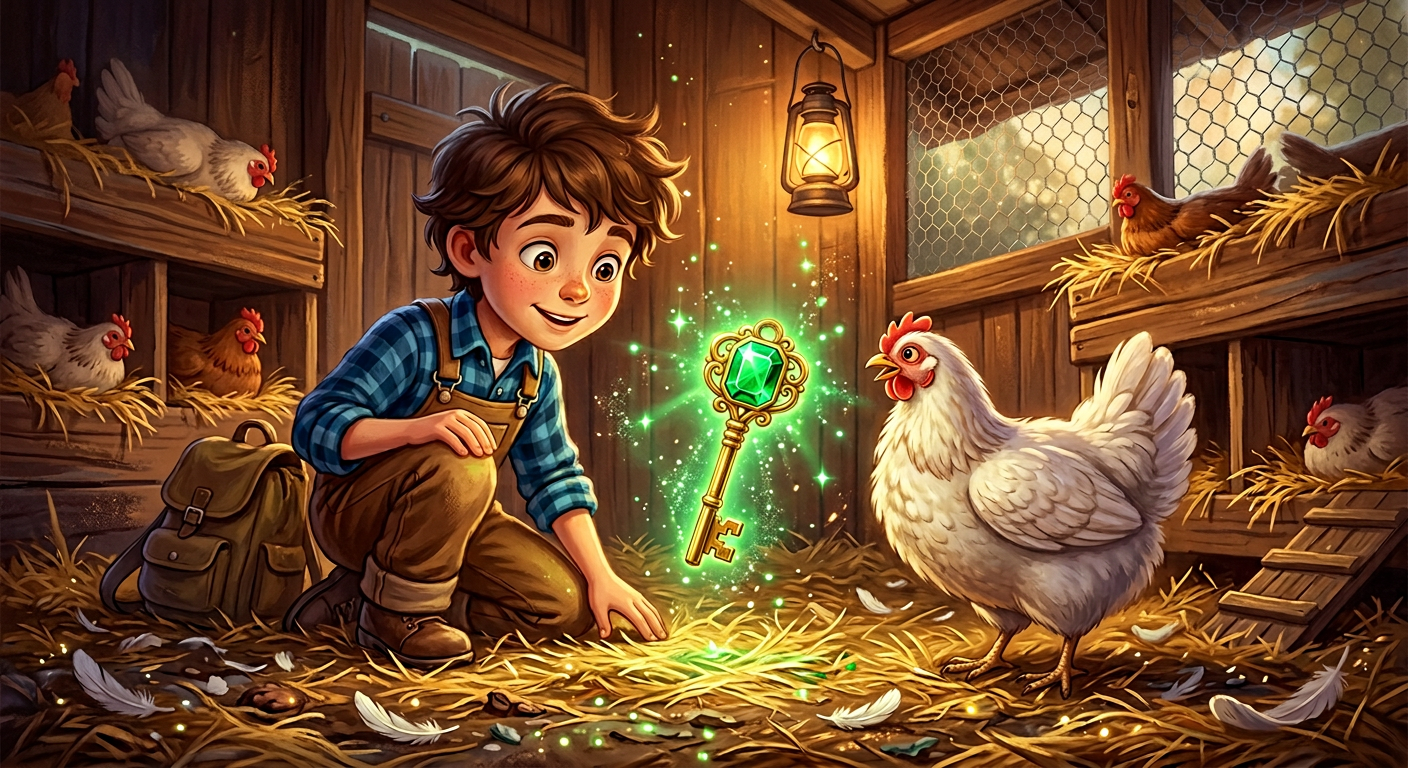
He was thirteen. Just doing his chores — collecting eggs, talking to his favorite hen the way you do when you think nobody’s listening — when the hay shifted and something caught the lantern light. Gold. Ornate. Alive with a green glow that had no business being there.

An emerald the size of his fist, set into the bow of an old key, hanging from a chain. It pulsed like a heartbeat. The hen tilted her head at him. He picked it up.

Nothing would ever be the same.

🗝️

“Some doors aren’t built to be found.
They wait until you’re ready.”

A young brown-haired boy discovers a glowing gold and emerald magic key in a rustic chicken coop a white hen watching nearby


Chapter Four

The Magic Tree

The key led him into the woods. Deeper than he’d ever gone — past the familiar paths, past where the light still reached comfortably. The chicken followed. She always followed.

And then he saw it.

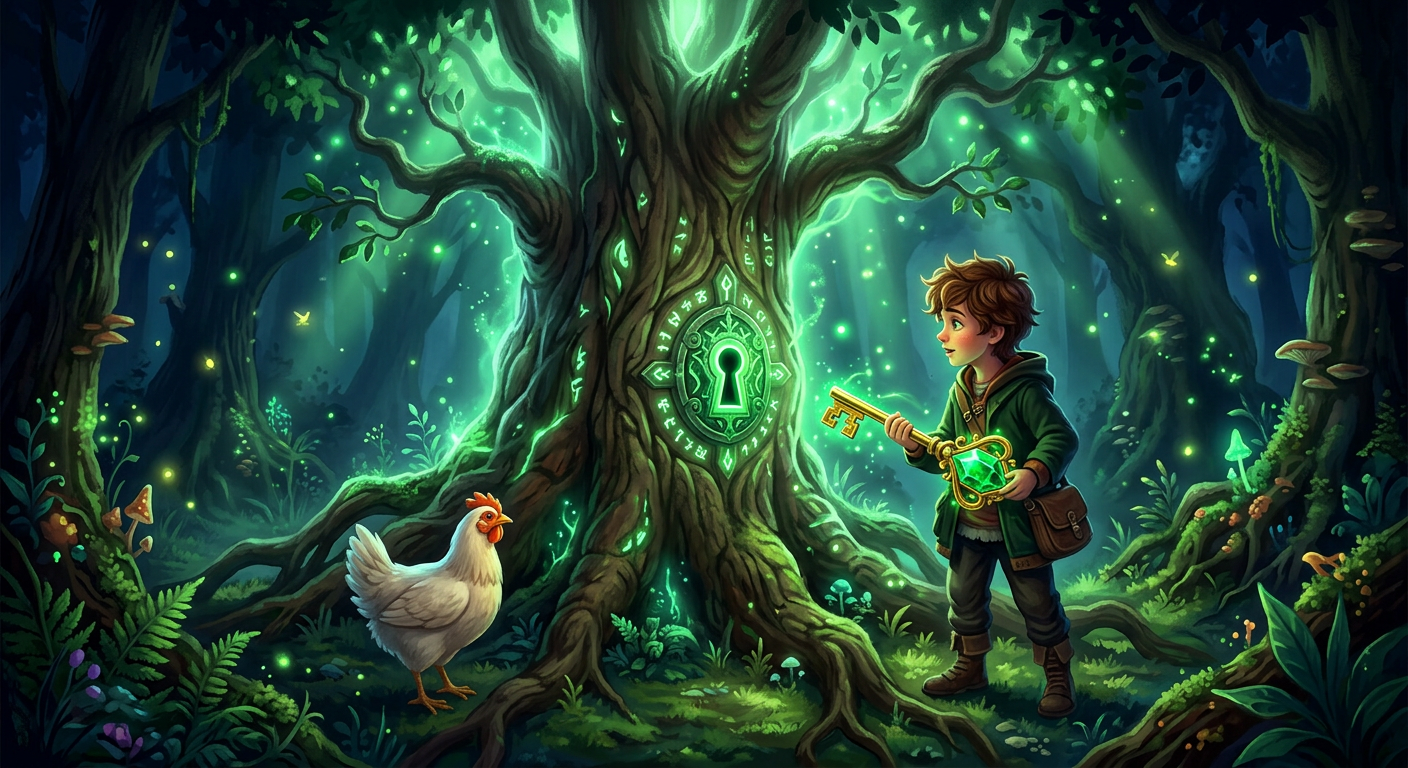
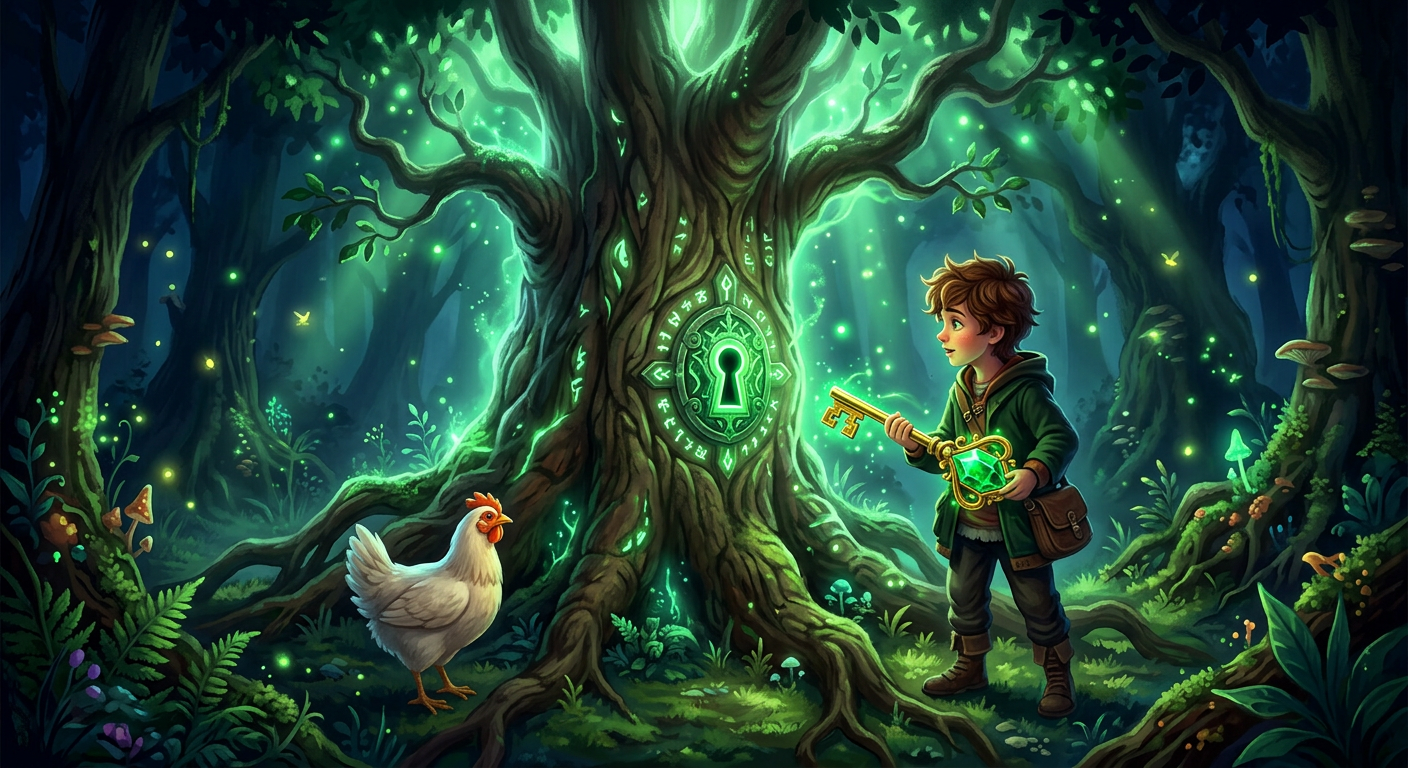
An ancient tree, massive and impossible, radiating soft green light from deep within its bark. Runes carved in circles around a lock set perfectly at eye level — a keyhole that could only belong to one thing.

He held up the key. It glowed brighter. The forest went quiet. He turned it.

A young boy holds a glowing emerald key before an ancient magic tree in a dark forest a white chicken beside him


Chapter Five

The Yellow Brick Road

The tree opened like a door. Beyond it — the road. Gold and gleaming, winding through a world that breathed green light and smelled of roses.

He wasn’t alone for long. A girl with long blonde hair and a blue and yellow dress appeared — Alice, she said, though she didn’t seem entirely sure that was her real name. Her black cat came with her, trotting along the bricks without invitation, as cats do.

The three of them walked. The Emerald City shimmered in the distance, impossibly beautiful. And between them and it — a black silhouette under red lightning. A witch. Waiting.

Behind them, a tornado churned. Ahead, a reckoning. The road was the only choice.

Alice and a young boy walk hand in hand down the yellow brick road toward the Emerald City a black cat at their side and a witch silhouette under red lightning in the distance


The story continues…

Stream Spiral — the single from the upcoming Solarbluseth album Sonata

Uncategorized

sonotica

Sonotica - The Announcer
A Radio Dramedy by SolarBluSeth
Sonotica
the pornography of sound

Now Playing

The signal goes everywhere. And whoever catches it… catches it.
Sonotica is an AI-generated audio drama built around the seduction of the human voice. A late night radio host. Two callers. A triangle no one admits to until the signal goes dark.
Built around phonaesthetics — the idea that sound itself can seduce — this 8-minute radio dramedy asks what happens when a voice becomes the content. No visuals. No context. Just frequency and whoever is listening.
Written, directed, and produced entirely with AI voice synthesis by SolarBluSeth.

SolarBluSeth
Cast
The Announcer
Seth
Deep. Resonant. Selective. Voice cloned via ElevenLabs. He never chooses sides.

Lover A
Lily
Warm. Velvety. Intimate. She almost hung up.

Lover B
Jessica
Bold. Playful. Electric. She waited. She called anyway.

Built With
Claude AI — Script
ElevenLabs — Voice
ElevenLabs — Images
PHP — TTS Pipeline
FFmpeg — Audio
MAGIX Music Maker
Adobe Premiere Pro
SolarBlu.net

Sonotica Radio Studio
The signal is always here.
You just have to tune in.

Sonotica – SolarBluSeth – 2026
Solarbluseth
Scroll to Top