Author name: solarbluseth

Uncategorized

Spiraling-Songbook

๐ŸŒ€

SPIRALING

The new album from Solar Blu โ€” 12 all-original tracks, 48 minutes, out everywhere now.

Listen to Spiraling ๐ŸŽง

A Storybook, On Us ๐Ÿ“–

To celebrate the release of Spiraling, we made you something to keep:
a storybook to read while you listen. Flip through it below, or download
the PDF and take it with you. Free, always.

Your browser can't display the PDF here โ€” no problem.Download the Storybook


Uncategorized

The VM Update That Almost Ended Me (and Then I Made 10 Cold Calls Anyway)


The VM Update That Almost Ended Me (and Then I Made 10 Cold Calls Anyway)

SolarBluSeth ยท Monday recap

Running a one-man web shop means there’s no “not my department.” Today was a perfect example โ€” and yeah, it’s Monday, so of course it started like this.

Part 1: The Nightmare

Woke up (or never really went to sleep, depending on how you count it) to find one of my machines in a full-blown virtual machine update nightmare. You know the kind โ€” everything was fine yesterday, you let an update run, and suddenly you’re staring at a VM that won’t cooperate and a sinking feeling that today’s plans just got hijacked.

The actual culprit this time? An old Visual Basic script that needed updating to play nice again. Anyone who’s kept a business running for 30 years knows exactly what this is like โ€” there’s always some quietly load-bearing piece of legacy code sitting in the corner, doing its job for years, until an update comes along and reminds you it’s still there.

So that was the morning: digging back into old VB code, figuring out what broke, patching it up, and getting the machine back on its feet.

Part 2: Then I Just… Went to Work

Here’s the thing about running your own shop โ€” you don’t get a day off just because your morning turned into a computer crisis. So once the machine was breathing again, I pivoted straight into lead gen mode: 10 cold calls to potential new clients.

No fanfare, no big production. Just picked up the phone and started dialing after wrestling a VM back to life. That’s the actual job โ€” not glamorous, but that’s how SolarBlu keeps moving.

The Monday Tax

Only Monday, and already a full VM crisis plus a round of cold calls. If this is the opening act, the rest of the week better be paying attention.

The Takeaway

Some days are “fix the ancient script that’s holding everything together” days. Some days are “get on the phone and find new business” days. Today was both, back to back, no break in between. That’s freelance web life โ€” you’re sysadmin, developer, and salesperson before lunch, and nobody’s coming to save you if the VM doesn’t boot.

Tomorrow it’ll probably be something else entirely. That’s kind of the fun of it.


Uncategorized

WordPress Isn’t Dead. You Just Never Learned It.

WordPress Isn’t Dead. You Just Never Learned It.

Every few months, another “hot take” video shows up telling you WordPress is dying. Dead. Over. Move to Webflow, move to Squarespace, move to whatever the sponsor is this week.

I’m calling it: that’s not analysis, that’s an ad. And it’s wrong.

The numbers don’t lie

WordPress still powers over 40% of the entire internet. Not 40% of “CMS websites” โ€” 40% of every website that exists. Yes, that share dipped slightly this year. A platform running four out of every ten sites on Earth cooling off by a point or two isn’t a death spiral, it’s gravity.

“Hard to use” is a 2015 argument

The loudest complaint is that WordPress is clunky, technical, only for developers. I run my sites on Elementor, and that argument hasn’t been true for years. Drag, drop, publish. My team edits pages together in real time, leaves notes directly on the elements that need changes, and tags each other when something needs a second look โ€” no code, no FTP, no calling in a developer because someone wants to swap a headline.

That’s the part the “dead” crowd conveniently skips: you don’t need to be a tech administrator to be a WordPress editor anymore. If you can use Google Docs, you can run a WordPress site built on Elementor.

Support isn’t optional, it’s the point

The other half of the “WordPress is scary” myth assumes you’re on your own. You’re not, if you set it up right. Expert support exists precisely so a small business owner doesn’t need to become a sysadmin โ€” updates, security, backups, the boring-but-critical stuff, handled, while the team focuses on content.

The real cost of “you’ll always need a developer”

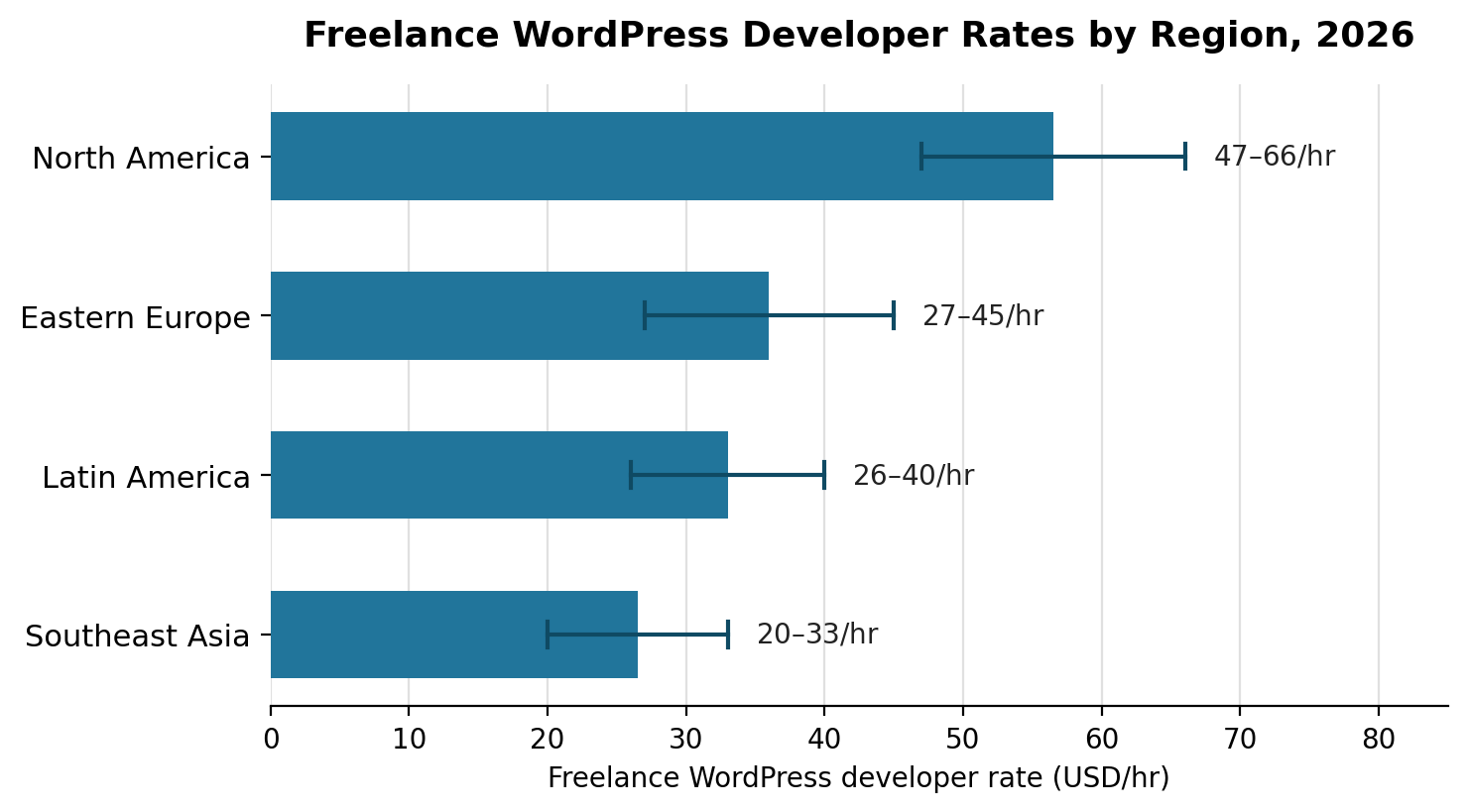
Here’s what the “go build it somewhere else” crowd conveniently skips: hiring a developer for every little change isn’t free, and it isn’t fast. Freelance WordPress developer rates in 2026 swing from about $20โ€“33/hr in Southeast Asia to $47โ€“66/hr in North America, with senior US specialists topping $150/hr for custom plugin or headless work. Eastern Europe and Latin America land in between, roughly $26โ€“45/hr. On top of that, 45% of employers worldwide say they’re struggling to fill web development roles at all โ€” the talent gap is real, and it’s making dev time more expensive, not less.

Bar chart of freelance WordPress developer rates by region in 2026

Rates are broad market ranges for experienced freelancers; senior specialists on complex work bill well above these figures. Source: 2026 freelance rate surveys (Arc.dev, Index.dev).

That’s exactly the gap Elementor closes. Every hour you don’t have to pay a developer to fix a typo or swap an image is an hour your budget goes toward growth instead of maintenance. WordPress didn’t get harder to justify โ€” it got cheaper to run.

What’s actually true

WordPress isn’t standing still. There’s active development on collaboration tools, better block editing, AI features with real guardrails โ€” it’s evolving, not decaying. What’s dying is the assumption that “open source and flexible” automatically means “hard and outdated.” That stopped being true once tools like Elementor made real-time team collaboration and no-code editing the default experience.

So next time someone tells you WordPress is dead, ask them when they last actually used it. My guess: not recently.

Uncategorized

If You’re Spending $5K on Facebook Ads, a Typo Isn’t Cosmetic ; It’s an Accountability Problem

If You’re Spending $5K on Facebook Ads, a Typo Isn’t Cosmetic – It’s an Accountability Problem

There’s a wave of ad creative right now that’s obviously AI-generated and unedited: awkward phrasing, misspellings, copy that reads like a first draft nobody looked at twice. It’s easy to blame the tool. The tool isn’t the problem. Somebody was handed a $5,000 budget, generated the copy, and shipped it without anyone checking the work. That’s not an AI problem — that’s nobody being held to a standard.

The Tool Didn’t Skip the Proofread, a Person Did

AI copy generation is a legitimate way to produce drafts fast. That’s what it’s for. The failure isn’t that the draft had errors — early drafts always have errors, that’s what makes them drafts. The failure is that whoever ran the campaign treated the output as finished work instead of a first pass that still needed a human to check it. Somewhere in that process, either nobody owned “review before launch” as part of the job, or somebody owned it and didn’t do it. Either way, that’s a standards gap, not a technology gap.

What This Looks Like When Accountability Actually Exists

In a shop with real standards, AI-generated ad copy doesn’t go live raw. Someone reads it out loud before launch, checks spelling, confirms the offer makes sense, confirms it matches the brand’s voice — and that step isn’t optional or dependent on whether someone “gets around to it.” It’s built into the process the same way a final review is built into any other deliverable that costs money if it’s wrong. When that step is missing, it’s usually because nobody defined it as part of anyone’s job, or because it was defined and nobody enforced it.

Why This Keeps Happening

It’s happening at scale right now because AI makes it possible to generate huge volumes of ad variations with almost no effort, and that volume creates an illusion of productivity. Producing twenty ad variants in five minutes feels like progress. But volume without a review step doesn’t produce twenty good ads — it produces the same uncaught mistake copied twenty times. The tool made the output faster. It didn’t make anyone more accountable for what went out the door.

The Money Is Just Where the Failure Becomes Visible

The cost is real — sloppy, error-riddled ads get lower engagement, and Meta’s delivery system charges more per result for ads that underperform, so the mistake does show up on the invoice. But the invoice is a symptom, not the root cause. A team that lets typo-ridden copy go live on a $5,000 campaign would very likely let the same thing slide on a client deliverable, an internal report, or a product page — the ad spend just happens to be where the lack of a review standard becomes expensive enough to notice.

The Fix Isn’t a Better Tool

It’s a defined, enforced step: nothing generated by AI ships without a specific person reading it and signing off before it goes live. That’s not a technology upgrade. It’s a management decision — deciding that “good enough to launch” requires a human check, and then actually holding whoever owns that step to it. Skip that decision, and it doesn’t matter how good the AI gets. The next mistake just gets generated faster.

Uncategorized

What Freelancers Should Actually Charge in 2026 (And Why Bid Sites Are Racing You to the Bottom)

What Freelancers Should Actually Charge in 2026 (And Why Bid Sites Are Racing You to the Bottom)

If you’ve spent any time bidding on Upwork or Freelancer.com, you already know the pattern: you quote a fair rate for real, skilled work, and someone underbids you by 50% within the hour. It’s easy to start thinking that’s just what the market pays. It isn’t. It’s what a specific slice of the market โ€” clients hunting for the cheapest possible bid โ€” pays. The rest of the market, the one paying actual professional rates, is mostly invisible on the first page of open jobs.

Here’s what the data actually says, and how to price yourself against it instead of against the bottom of a bid list.

The National Numbers

For WordPress work specifically, freelance rates break down roughly like this:

  • Entry-level: $15โ€“40/hr
  • Mid-level: $40โ€“80/hr (averaging around $73/hr)
  • Senior / specialized (custom plugin work, WooCommerce, security hardening): $80โ€“150+/hr, averaging around $128/hr

Specialized skills carry a real premium โ€” security hardening and WooCommerce work typically add 15โ€“40% on top of a base rate, because fewer people can do them reliably.

For general freelance web development, the U.S. median sits closer to $85/hr, with experienced developers commonly billing $95โ€“160/hr.

New York and Chicago

Location shouldn’t gate what you charge a U.S.-based client, but it’s useful context for anchoring an ask:

  • New York: averages around $46/hr broadly, but experienced or specialized developers in that market routinely bill $85โ€“150+/hr.
  • Chicago: averages around $45/hr.

If a client is based in a major U.S. metro, there’s no reason to default to a global-average rate just because the job is posted on a platform with a lot of $10/hr bids sitting next to yours. The client’s budget reality and the platform’s visible bid range are two different things.

The Formula for Setting Your Own Rate

Most freelancers underprice because they calculate rate backward from “what sounds competitive” instead of forward from what they actually need to earn. The standard formula:

Hourly rate = (Target take-home income + business expenses) รท ((1 โˆ’ tax rate) ร— billable hours)

A few things people consistently forget when running this math:

  • Billable hours are lower than you think. Most freelancers only bill 60% of their working time โ€” the rest goes to admin, proposals, and client management. If you work 40 hours a week, that’s realistically 20โ€“25 billable hours.
  • Self-employment tax is separate from income tax. As a freelancer you pay both the employee and employer halves of Social Security and Medicare โ€” an extra 15.3% on top of federal and state income tax that a salaried job would split with an employer.
  • “Competitive” bids on low-budget platforms are often not sustainable rates โ€” they’re rates set by people who haven’t run this math, or who are pricing for a different cost of living entirely.

Run the numbers with your real expenses and tax bracket, and $22/hr is very likely below what the math says you need โ€” not just below what the market says you’re worth.

Why the Bid Platforms Skew Low

Upwork, Freelancer.com, and similar bid-based marketplaces are structurally built for downward pressure: dozens to hundreds of freelancers competing for a single posted budget, often set by a client with no real sense of what the work costs. That’s a very different pool than the client base hiring through referrals, agencies, or platforms like Fiverr, where you set the price and buyers come to you instead of underbidding each other for your attention.

None of that means bid platforms are useless โ€” they’re a real source of work and relationship-building. It means treating every low-budget listing as “the market rate” is a mistake. The actual market rate is closer to $40โ€“80/hr for solid mid-level WordPress work, $85โ€“150+/hr for specialized or metro-market clients, and it’s worth pricing toward that number rather than toward whatever the lowest bid in the queue happens to be.

The Practical Takeaway

  • Calculate your real rate using the formula above before you look at any job board.
  • Treat platform bid ranges as one data point, not the ceiling.
  • Reserve the rock-bottom-budget jobs for cases where your own technique or automation makes the work fast enough that the low rate still nets out fine per hour.
  • When a U.S. client is on the other end, it’s reasonable to quote toward U.S. mid-market rates, regardless of what other bidders on the same listing are asking.

Underpricing doesn’t just cost you money on one job โ€” it resets the baseline a client expects to pay you on every job after it. Charge like the professional you are, and let the clients who can’t meet that number self-select out.

Uncategorized

From Solo Grind to Global Outsource

From Solo Grind to Global Outsource

Building a Sustainable International Practice

The thing about freelancing is nobody tells you the real story.

They show you the Instagram posts about “digital nomad life” and “work from anywhere.” What they don’t show you is the 3 AM panic when a client goes silent. The month you land three projects and then six months with nothing. The slow realization that trading hours for money doesn’t scaleโ€”it just exhausts you.

I spent 30 years building websites. Thousands of them. I learned WordPress before it was cool. I built proprietary frameworks. I managed teams. I watched the web evolve from static HTML to full-blown applications. And somewhere along the way, I realized I was still grinding the same way I started: one project at a time, always hunting for the next client.

Then something shifted.

The Problem with “Do Everything Yourself”

For decades, I operated the traditional freelancer playbook:

  • Build a portfolio
  • Pitch clients relentlessly
  • Win projects
  • Deliver work
  • Hunt for the next thing
  • Repeat

It’s exhausting. And the worst part? You’re completely replaceable. Anyone can build a WordPress site with Elementor. Your only leverage is price or availability.

I started noticing patterns in the clients who stuck around. They weren’t the cheapest projects or the biggest budgets. They were the ones where I built something proprietaryโ€”frameworks and tools they couldn’t get anywhere else. Advanced Themer was one of those. It became part of their workflow. They couldn’t just hire someone else and replicate it.

Those clients? They kept coming back.

The Recruiter Partnership Changed Everything

Instead of chasing every opportunity, I started thinking differently: What if someone else did the sourcing?

Enter the recruiter model. Instead of spending 40% of my time on sales calls and vetting tire-kickers, a recruiter finds clients, vets them, and brings the good ones to me. They take a small percentage. I focus on delivery.

The beautiful part? Those clients started being internationalโ€”EU and Australia mostly. Clients I never would have found on my own.

And here’s the thing about international clients: they value reliability over proximity. They don’t care that you’re in a different timezone if you deliver consistent, quality work. They care that you understand their business and that they can depend on you.

From Projects to Partnerships

Once the recruiter started bringing EU and AU clients, something interesting happened.

Instead of one-off projects that ended and required hunting again, I started landing clients who wanted ongoing support. Monthly retainers. Standing relationships. They’d come back because:

1. The work is solid

30 years of experience means I know what actually works

2. The proprietary tools matter

Advanced Themer isn’t something they can replicate with a new freelancer

3. The relationship is built

When you deliver consistently across timezones and manage expectations, clients trust you

Suddenly I wasn’t a freelancer hunting for gigs. I was an outsource partner in a global supply chain. The recruiter sources clients. I deliver. The client gets reliable, skilled work. Everyone wins.

Why This Model Actually Works

Here’s what most freelancers don’t understand about recurring revenue:

It’s not about the money (though that’s nice). It’s about predictability.

You know what’s coming next month. You can plan. You can breathe. You’re not constantly in survival mode.

And when you build with proprietary toolsโ€”frameworks that are yoursโ€”you create a moat. A client can’t just replace you with whoever undercuts your price. You’re embedded in their workflow.

International clients get this immediately. They’ve worked with cheap outsources who disappeared. They’ve dealt with quality issues and communication gaps. When they find someone who delivers consistently, speaks their language (literally and professionally), and has built something special into their siteโ€”they hold on tight.

The Real Advantage

The traditional freelancer game rewards volume: hustle more, pitch more, win more. Burn out faster.

The partnership model rewards reliability: show up consistently, deliver excellent work, build relationships that last.

One scales by burning out. The other scales by becoming more valuable.

Your clients don’t want another freelancer. They want a partner who understands their business, delivers work they can depend on, and uses tools and frameworks that actually solve their problems. That’s worth paying for. That’s worth keeping around.

Building Your Own Edge

If you’re reading this as a freelancer, here’s the real talk:

You can compete on price. Thousands of people will undercut you.

You can compete on availability. Someone’s always hungry.

Or you can build something proprietary. A framework. A process. A reputation for reliability that crosses borders.

Then find partners (recruiters, agencies, networks) who can bring you clients who value that edge.

You’ll never have to hustle the same way again.

The web has changed a lot in 30 years. But the fundamentals are the same: build things people can’t build without you. Deliver consistently. Show up across timezones. Let the relationships compound.

That’s not a hustle. That’s a practice.

Want to Build a Sustainable International Web Practice?

Let’s talk about how proprietary tools and strategic partnerships can transform your freelance career.


Get In Touch โ†’

Uncategorized

spiral


Spiral cover art

Spiral โ€” An Original Story
Baby in basket on the river from the Emerald City

Chapter One โ€” Sent From the Emerald City
Boy growing up on the farm collage

Chapter Two โ€” The Farm Years
Boy finds glowing emerald key in chicken coop

Chapter Three โ€” The Key in the Chicken Coop
Boy at the magic tree in the dark forest

Chapter Four โ€” The Magic Tree
Alice and the boy on the yellow brick road

Chapter Five โ€” The Yellow Brick Road


Solarbluseth โ€” An Original Story

Spiral

Follow the road. Face the darkness. Find your way home.


Chapter One

Sent From the Emerald City

Before the boy ever walked a farm road or heard a rooster crow, he floated. A tiny baby in a wicker basket, wrapped in soft light, carried by a river that wound through a land he would not remember โ€” not yet.

The Emerald City glowed behind him. Something had gone wrong there. Something had sent him away. The river carried him toward a swirling vortex, and on the other side โ€” the amber glow of a city called Chicago, flickering with lightning.

The human world received him without fanfare. A farm. A family. A new life.

A baby in a wicker basket floats down a glowing river from the Emerald City toward a vortex portal over Chicago


Chapter Two

The Farm Years

He grew up the way farm boys do โ€” slowly, honestly, with dirt under his fingernails and stars overhead that felt close enough to touch. He didnโ€™t know where he came from. Nobody did.

He learned to walk in the meadow, to ride a bike down a sunflower-lined road, to stare in fascination at a glowing computer screen. He read in haylofts with a flashlight. He studied until the lamp burned low. Whatever was in him โ€” whatever the Emerald City had put there โ€” was becoming something.

A nostalgic collage of a boy growing up on the farm from baby to age 13 connected by glowing green magical light


Chapter Three

The Key in the Chicken Coop

Every great story starts somewhere unexpected. This one started in a chicken coop.

He was thirteen. Just doing his chores โ€” collecting eggs, talking to his favorite hen the way you do when you think nobodyโ€™s listening โ€” when the hay shifted and something caught the lantern light. Gold. Ornate. Alive with a green glow that had no business being there.

An emerald the size of his fist, set into the bow of an old key, hanging from a chain. It pulsed like a heartbeat. The hen tilted her head at him. He picked it up.

Nothing would ever be the same.

๐Ÿ—๏ธ

โ€œSome doors arenโ€™t built to be found.
They wait until youโ€™re ready.โ€

A young brown-haired boy discovers a glowing gold and emerald magic key in a rustic chicken coop a white hen watching nearby


Chapter Four

The Magic Tree

The key led him into the woods. Deeper than heโ€™d ever gone โ€” past the familiar paths, past where the light still reached comfortably. The chicken followed. She always followed.

And then he saw it.

An ancient tree, massive and impossible, radiating soft green light from deep within its bark. Runes carved in circles around a lock set perfectly at eye level โ€” a keyhole that could only belong to one thing.

He held up the key. It glowed brighter. The forest went quiet. He turned it.

A young boy holds a glowing emerald key before an ancient magic tree in a dark forest a white chicken beside him


Chapter Five

The Yellow Brick Road

The tree opened like a door. Beyond it โ€” the road. Gold and gleaming, winding through a world that breathed green light and smelled of roses.

He wasnโ€™t alone for long. A girl with long blonde hair and a blue and yellow dress appeared โ€” Alice, she said, though she didnโ€™t seem entirely sure that was her real name. Her black cat came with her, trotting along the bricks without invitation, as cats do.

The three of them walked. The Emerald City shimmered in the distance, impossibly beautiful. And between them and it โ€” a black silhouette under red lightning. A witch. Waiting.

Behind them, a tornado churned. Ahead, a reckoning. The road was the only choice.

Alice and a young boy walk hand in hand down the yellow brick road toward the Emerald City a black cat at their side and a witch silhouette under red lightning in the distance


The story continuesโ€ฆ

Stream Spiral โ€” the single from the upcoming Solarbluseth album Sonata

Uncategorized

sonotica

Sonotica - The Announcer
A Radio Dramedy by SolarBluSeth
Sonotica
the pornography of sound

Now Playing

The signal goes everywhere. And whoever catches it… catches it.
Sonotica is an AI-generated audio drama built around the seduction of the human voice. A late night radio host. Two callers. A triangle no one admits to until the signal goes dark.
Built around phonaesthetics — the idea that sound itself can seduce — this 8-minute radio dramedy asks what happens when a voice becomes the content. No visuals. No context. Just frequency and whoever is listening.
Written, directed, and produced entirely with AI voice synthesis by SolarBluSeth.

SolarBluSeth
Cast
The Announcer
Seth
Deep. Resonant. Selective. Voice cloned via ElevenLabs. He never chooses sides.

Lover A
Lily
Warm. Velvety. Intimate. She almost hung up.

Lover B
Jessica
Bold. Playful. Electric. She waited. She called anyway.

Built With
Claude AI — Script
ElevenLabs — Voice
ElevenLabs — Images
PHP — TTS Pipeline
FFmpeg — Audio
MAGIX Music Maker
Adobe Premiere Pro
SolarBlu.net

Sonotica Radio Studio
The signal is always here.
You just have to tune in.

Sonotica – SolarBluSeth – 2026
Uncategorized

living with hiv

 
Living with HIV+  |  Pride Month 2026  |  Behind the Scenes
โœ๏ธ SolarBluSeth    ๐Ÿ“… June 12, 2026    ๐Ÿณ๏ธโ€๐ŸŒˆ Pride Month    ๐ŸŽต Glitterati

You Need a Hero โ€” Living with HIV campaign hero image

It Started with a LinkedIn Post

This morning I woke up and did something I've never done before. I posted on LinkedIn and told the world I have AIDS.

Not in a dramatic way. Not asking for sympathy. Just โ€” the truth. I lost my job. I lost my benefits. I went almost a week without my HIV medications. And today I was taking an FMLA day to fight through the red tape and get things back on track.

By the time I hit publish I wasn't sure what would happen. Within hours it had over 100 views. And then my phone rang. It was Dan โ€” a sales manager from my former employer. Not calling on behalf of the company. Just calling because he's a good person who saw a post and wanted to check in.

That call reminded me why I posted in the first place.

"Shame doesn't save lives. Information does. Community does. Showing up does."

The FMLA Day That Became a Full Production

I spent the first two hours of the morning buried in Social Security paperwork. Documentation printed. Calls made. Doctor looped in. My doctor reached out to the manufacturer directly to get my medications covered during the gap. By mid-morning the serious stuff was handled.

And then โ€” I pivoted. Because I had something to say. And I had the tools to say it.

Morning

Filed SSA paperwork, printed documentation, coordinated with doctor on medication coverage through manufacturer program.

Late Morning

Wrote and published the LinkedIn post. 100+ views by afternoon. Phone call from Dan.

Afternoon

Built the "Living with HIV+" blog article with AI-generated campaign images from ElevenLabs. Five images, five sections, Pride rainbow styling throughout.

Mid Afternoon

Created the Gilead thank-you collage โ€” four AI images in a 2ร—2 grid with "Living in yellow, with HIV+ in red" center text. Pride stripes top and bottom.

Late Afternoon

Wrote and recorded the 6-minute "HIV Don't Stop and Neither Do I" video script. Edited in Premiere Pro. Added captions. Layered in Glitterati from the Sonata project as the background score.

Evening

This blog post. Because the day deserved to be documented.

The Campaign โ€” "You Need a Hero"

Living with HIV+ campaign โ€” campus walking

AI-generated campaign imagery from ElevenLabs โ€” part of the "You Need a Hero" series

The visual campaign came together fast. I'd been generating AI images in ElevenLabs using myself as a reference โ€” and what came back genuinely surprised me. The glasses. The beard. The expression. It looked like me. Living. Thriving. Not performing wellness โ€” actually being it.

Four images. Yellow hoodie. Campus scenes. A desk with a cat. A figure on a bike. Each one carrying little text fragments baked right into the illustration: Still here. Still me. Still thriving. HIV+ โ€” not just a label, it's part of me, not all of me.

Living with HIV+ campaign โ€” desk and cat

The color language is intentional. Living in yellow. HIV+ in red. Warm. Alive. Not clinical. Not scary. Just real.

HIV Don't Stop and Neither Do I โ€” The Video

Living with HIV+ campaign composite image

The video script came out of everything I've been sitting with. Fifteen years of living with this. The week without meds. The paperwork. The phone calls. The biking down country roads in Illinois just because I can. Because my body lets me. Because the medications work.

I wrote it in one sitting. Six minutes. No fluff.

And then when it came time to add music โ€” I almost went to YouTube Audio Library like I always do. But something made me pause. I've been working on Sonata โ€” my live piano practice album. And I had a new track called Glitterati.

๐ŸŽน About Glitterati
A new track from the Sonata project โ€” recorded on the Arturia KeyLab Essential 61 with SampleTank 4. Layered under the HIV campaign video at 27% volume. The contrast between the warm glittery energy of the music and the weight of the story creates something neither could do alone.

My own music. Under my own story. About my own life. At 27% volume it sits perfectly โ€” present but never competing. It gives the viewer emotional permission to feel something without telling them what to feel.

I cried editing it. That's how I knew it was right.

Thank You, Gilead

Living with HIV+ campaign โ€” yellow hoodie bench scene

I want to say this clearly and publicly: Gilead Sciences has been part of keeping me alive for 15 years.

And when I hit that coverage gap โ€” when the insurance disappeared and the clock started ticking โ€” their Advancing Access program is what bridged it. Real help. Real people. Real fast.

If you are living with HIV or AIDS and you are in a coverage gap, uninsured, underinsured, or just don't know how you're going to afford your next prescription โ€” please use this resource right now:

Gilead Sciences

Gilead Advancing Access Program

Support for patients who need help affording their HIV medications โ€” regardless of insurance status. Don't go without your meds because of a coverage gap.

Get Help Now โ†’ gileadadvancingaccess.com/patient

What Pride Means This Year

Pride was born from people who were told they were too sick, too broken, too much. People who showed up anyway. Who marched anyway. Who loved anyway.

This year Pride means filing the paperwork. Making the calls. Getting on the bike even when your body is tired. Posting the truth on LinkedIn even when your hands are shaking. Making the video. Writing the blog post. Doing the whole damn thing in one day because you have something to say and you're still here to say it.

Fifteen years. Still here. Still building. Still creating. Still riding.

"HIV don't stop. And neither do I."

What's Next

The video goes up on YouTube, TikTok, and across all my platforms. The campaign images will roll out across social media through Pride Month. The biking photos are next โ€” a whole series of "stopped on the road to document that I'm still moving" content.

And Sonata keeps growing. Glitterati is just one track. There's a whole album being built โ€” live, in real time, one piano session at a time. Come watch it happen.

If this post reached you โ€” share it. Tag someone who needs it. Post the Gilead link in your bio. Be loud about the things we're supposed to be ashamed of. Because shame doesn't save lives. But showing up does.


โ€” SolarBluSeth  |  June 12, 2026

๐Ÿณ๏ธโ€๐ŸŒˆ Resources
HIV medication assistance: gileadadvancingaccess.com/patient

Ryan White HIV/AIDS Program: hrsa.gov/ryan-white-hiv-aids-program

SolarBluSeth is a web developer, entrepreneur, musician, and content creator based in central Illinois. He runs SolarBlu.net LLC and creates music, streams, and content across YouTube, Twitch, Kick, TikTok, and Instagram. He has been living with HIV/AIDS for 15 years and is an open advocate for destigmatization, access to care, and showing up even when it's hard. Follow everywhere: @solarbluseth
 
Uncategorized

living with it


Mental Health & Pride Month 2026

Staying Alive Is Harder Than It Seems Sometimes

A Mental Health Day, FMLA, Pride Month, and What It Really Means to Still Be Here

You Need a Hero โ€” hero image for the campaign

I Put It Out There Today

This morning I posted something on LinkedIn that I’ve been sitting with for a while.

I told people I have AIDS.

I told them I haven’t had my medications in almost a week. That I lost my job, my benefits, and some of my stability all at once. And that today โ€” right now โ€” I’m taking an FMLA day to cut through the red tape and get things back on track.

I didn’t post it for sympathy. I posted it because sometimes the bravest thing you can do is say this is hard out loud โ€” and then show people what you do next.


Close-up of hands working through paperwork

What a Mental Health Day Actually Looks Like

Pop culture wants you to believe a mental health day means bubble baths and scented candles and journaling in a sunlit room.

For a lot of us, it looks like two hours of filling out Social Security paperwork. It looks like printing documentation and calling your doctor’s office to ask them to contact the manufacturer directly because you can’t wait for insurance to get its act together. It looks like navigating systems that were not designed with sick people in mind.

That’s not glamorous. But it’s real. And doing that work โ€” finishing that work โ€” is an act of self-care just as much as any spa day.

“I love finishing tasks. I love looking back at the things I’ve done. There’s a quiet power in checking something off a list that used to feel impossible.”

Close-up of hands โ€” the work of staying alive

Today I checked off a lot.


Checklist with items checked off

Pride Month and the Weight of Still Being Here

It’s June. It’s Pride Month. And this year, Pride hits differently for me.

Living with HIV โ€” living with AIDS โ€” in 2026 is not a death sentence the way it once was. The medications work. The science has come so far. And yet, there are still days when staying alive feels like a part-time job. When the bureaucracy of survival โ€” the insurance calls, the paperwork, the benefits gaps, the advocacy you have to do just to access your own healthcare โ€” takes more out of you than the diagnosis itself.

Pride was born from people who were told they were too sick, too broken, too much. People who showed up anyway. Who marched anyway. Who loved anyway.

I’m showing up today. In my own way. At my own desk. With my stack of papers and my cold coffee and my determination to get it done.

That counts.


Pride themed imagery โ€” resilience not performance

You Don’t Have to Share Everything โ€” But It Helps Someone When You Do

I know not everyone can or should be as open as I was today. There’s risk in disclosure. There’s stigma that’s still very real. I’ve felt it. I’m not naive about it.

But here’s what I know: when I was first diagnosed, I needed to see people living. Not just surviving โ€” living. Talking about it. Being loud about it. Refusing to be ashamed of something that happened to their body.

If this post is that for even one person, it was worth it.

If you’re reading this and you’re in a coverage gap, a benefits nightmare, or a health crisis that feels like it’s drowning out everything else โ€” I see you. It’s a lot. The red tape is real and it’s exhausting and you shouldn’t have to fight this hard just to stay healthy.

But you can do it. One form at a time.


A window with sunlight โ€” forward motion and hope

What’s Next

Today I filed paperwork. I made calls. I got my ducks in a row.

Tomorrow I get back to building โ€” my business, my music, my content, my life.

That’s the thing about hard days. They’re not the end of the story. They’re just the part where you do the work nobody sees, so you can show up for the part everybody does.

Happy Pride. Stay alive. Do the hard thing first.

โ€” SolarBluSeth


SolarBluSeth is a web developer, entrepreneur, content creator, and streamer based in central Illinois. He runs SolarBlu.net LLC and creates across YouTube, Twitch, Kick, and TikTok.

If you or someone you know needs HIV care resources, the Ryan White HIV/AIDS Program can help connect you with local services: hrsa.gov/ryan-white-hiv-aids-program


Uncategorized

They Told Me to Stay in My Lane. I Didn’t.


ISP Fraud โ€ข Whistleblower โ€ข Tech

They Told Me to Stay in My Lane.
I Didn’t.

I spent four years as a web developer at a fiber internet company. I found $90 million in missing revenue. I reported it twice to leadership. Both times I was shut down. Then I was fired. This is the full story โ€” the technical methodology, the financial breakdown, the legal framework, and why I’m still talking about it.

SolarBluSeth
|
June 2, 2026
|
~15 min read
|
Whistleblower Series โ€” Part 1
3,000+
Unbilled accounts
$12.6M+
Missing revenue
$209,880
Lost every month
$0
Legally recoverable
$235M
Debt facility at risk
They Told Me to Stay in My Lane. I Didn't. โ€” SolarBluSeth

Before We Start

People are going to ask what I want out of this. Money? A lawsuit? My job back?

None of the above.

“I want to be heard. That’s it. I found something real, I reported it through the right channels, I was shut down, and I think the people whose money is on the line deserve to know what I know.”

I’m not bitter. I’m not on a revenge tour. I’m a web developer with thirty years of experience who ran a technical audit, found something serious, tried to do the right thing, and got told to mind my own business. Twice. So now I’m doing the next right thing โ€” which is making sure the appropriate authorities know what I know.

The formal disclosures have already been filed. That process is underway. This post exists because the public deserves to understand how this kind of thing happens โ€” and because if you work at a fiber ISP right now, there is a chance this is happening at your company too.

How Fiber Internet Actually Works

To understand what I found, you need to understand one piece of hardware: the ONT.

When a fiber internet company installs service at your home or apartment, a technician installs a small device on your wall called an ONT โ€” Optical Network Terminal. It’s the endpoint of the fiber optic cable running into your building. It converts the light signal from the fiber into data your router can use.

When that ONT is powered on and active, it reports back to the company’s network management system in real time. It’s essentially saying: I’m here. I’m at this address. I’m live. I’m delivering internet service.

Fiber ISPs manage thousands โ€” sometimes hundreds of thousands โ€” of these devices across their networks. To do that at scale, they expose an API (Application Programming Interface) that allows internal systems to query the status of every ONT on the network. Which ones are active. Which ones are offline. What address each one is at.

Now โ€” separately โ€” the company has a billing system. That’s where customer accounts live. Customer name. Email address. Service address. What plan they’re on. What they owe each month.

In a properly functioning company, every active ONT maps to a customer record in the billing system. One device. One customer. One invoice per month. That’s the contract. That’s the revenue.

The Key Principle

An active ONT is proof of service delivery. It is hardware-verified, network-confirmed evidence that a real location is receiving live fiber internet. If that ONT has no corresponding billing record, the company is delivering service for free โ€” and has no idea it’s doing so.

What I Found โ€” The ONT Audit

As a web developer with access to internal systems, I had legitimate access to both the ONT API and the billing system exports. And being the kind of technically curious person I am, I decided to match them up.

Here’s exactly what I did:

1

ONT Data ExportI pulled a complete export of all active ONTs from the API โ€” every device on the network reporting live service delivery, including unit identifier, physical service address, and active/inactive status.

2

Billing System ExportI exported the complete customer database from the billing system โ€” every active customer account including name, email address, and physical service address.

3

Triple Cross-MatchI matched the two datasets against three independent fields: customer name, email address, and physical service address. A match on any one of the three fields counted as a valid billing record. I was being generous โ€” I wanted to eliminate false positives, not create them.

4

Triple VerificationAny ONT that returned no match across all three fields was flagged. I then went through the flagged results manually โ€” triple checking for data entry inconsistencies, address formatting differences, edge cases, and anything else that might create a false mismatch. I wanted to be absolutely certain before drawing any conclusions.

5

Rolling Revenue CalculationFor each confirmed unmatched ONT โ€” each device proven to be delivering live service with no billing record โ€” I calculated the revenue loss on a rolling monthly basis going back to the estimated service start date.

The result was unambiguous. Over 3,000 active ONTs had zero corresponding customer records in the billing system.

Three thousand physical devices. Delivering live fiber internet. To real addresses. Right now. With no invoice. No customer account. No revenue.

“This wasn’t a spreadsheet anomaly or an accounting estimate. These were hardware-verified, network-confirmed service deliveries with no billing record. The proof was in the devices themselves.”

The rolling revenue calculation was staggering. I built it month by month, going back through the estimated service period for each account. The number climbed fast. Really fast. Because that’s what happens when you multiply three thousand accounts by seventy dollars a month by dozens of months โ€” the math compounds in a way that doesn’t feel real until you’re staring at it.

The Financial Breakdown

Let me show you exactly how $90 million disappears. It’s simpler than you’d think.

Description Estimated Amount
Confirmed unbilled active ONTs (hardware verified) ~3,000+ accounts
Average monthly service fee per account $69.96 / month
Conservative unbilled period 36 months (3 years)
Unrecoverable revenue per account (3 years) ~$2,519
Total unrecoverable revenue โ€” 3-year base ~$7,555,680
Additional 2 years since first internal report (2 yrs ร— 3,000 ร— $69.96) +$5,037,120
Ongoing infrastructure / support costs for 3,000+ unpaid accounts Unquantified additional loss
Total estimated unrecoverable loss (conservative) ~$12,592,800+
Ongoing monthly exposure (still unresolved as of this post) ~$209,880 / month

That last line is the one that keeps me up at night. Every single month that passes without this being addressed, another $209,880 evaporates. Permanently. Because of the most important financial reality in this entire story:

Why the Money Is Gone Forever

You cannot retroactively bill a customer for service they received but were never invoiced for. They have no contract. They received no bills. They made no agreement to pay retroactively.

Under basic contract law and consumer protection law โ€” you simply cannot collect it. A court would throw that invoice out before you finished explaining the situation.

So every dollar represented in that table โ€” roughly $90 million and counting โ€” is gone. It was never real revenue. It can never become real revenue. The gap between what was represented and what was real is permanent and unrecoverable.

What Happened When I Reported It

I did what any responsible employee would do. I brought it up.

~2023 โ€” Report #1
Reported to VP

I brought the findings to a vice president. Explained what I found. Walked through the numbers. The response I received: “Stay in your own swim lane.” No investigation. No follow-up. No acknowledgment that the issue was real. Just โ€” mind your own business.

~2023 โ€” Report #2
Reported to Supervisor

I raised the same issue with my direct supervisor. Same result. No corrective action. No escalation. The billing gap remained open and the revenue kept not being collected.

~2023โ€“2024 โ€” Report #3
Reported to Interim Billing Manager

I brought it to the person literally responsible for billing operations โ€” the interim billing manager. No response. The individual most accountable for billing accuracy took no action whatsoever.

~Early 2025 โ€” Independent Discovery
Colleague Finds the Same Issue

A colleague independently discovered approximately 50 unbilled accounts and raised the issue internally. A corroborating witness observed the matter being dismissed without investigation โ€” for the third time. Same result. Swept under the rug.

May 2026 โ€” Present
Still Unresolved

To my knowledge, no formal audit has ever been commissioned. The affected customers remain unbilled. The revenue loss continues to compound at approximately $209,880 per month.

Why This Matters Beyond One Company

Here’s the part that keeps me talking about this even after everything.

This isn’t a sophisticated fraud. Nobody sat in a boardroom and hatched a scheme. What happened here is something much more mundane and much more dangerous: two systems that didn’t talk to each other, and a leadership team that didn’t want to hear about it.

The provisioning side of the business spins up service. A technician installs an ONT, activates it on the network, and moves on. The billing side of the business creates customer accounts. Somewhere in that handoff โ€” for thousands of accounts โ€” the billing record never got created. The ONT went live. The billing account didn’t.

Nobody noticed. Or nobody wanted to notice. And when someone did notice and raised it โ€” repeatedly โ€” the institutional response was silence.

For ISP Operators Reading This

Pull your active ONT list. Pull your billing records. Cross-reference them by physical address. If you find gaps โ€” and some of you will โ€” you now have the methodology to quantify them. The longer you wait to find this, the bigger the number gets. And the bigger the number gets, the worse it looks when it’s eventually found by someone who isn’t on your payroll.

The Investor and Lender Dimension

This story would be significant on its own as a billing operations failure. But there’s a layer on top of it that moves this into entirely different legal territory.

This company received a significant preferred equity investment from a major institutional investor โ€” based in part on represented customer counts and revenue figures. It subsequently secured a $235 million debt facility from a major international bank โ€” also based on represented operational scale.

If the approximately 3,000+ unverified, unbilled accounts were included in any customer count or revenue representation made to either of those parties during due diligence or ongoing reporting โ€” then both transactions were consummated on the basis of materially inaccurate financial information.

Under ASC 606 โ€” the GAAP standard for revenue recognition โ€” revenue can only be recognized when performance obligations are satisfied and collectibility is probable. Customers who have never been invoiced fail that test. Their inclusion in any revenue or customer count representation constitutes a material misstatement of financial condition.

That is not a billing operations problem anymore. That is a securities and investor fraud problem.

The Legal Framework

I want to be clear about something: I am not a lawyer. None of this is legal advice. But I do know how to read case law, and the precedents in this area are not ambiguous.

Case / Authority Why It Matters Here
SEC v. Lucent Technologies2004 โ€” $25M Settlement Lucent settled SEC charges for counting revenue that had not been earned. The parallel to counting customers who were never billed is direct and uncomfortable.
United States v. Ebbers (WorldCom)403 F.3d 173 (2d Cir. 2005) CEO convicted of securities fraud for inflating reported revenue figures. Established that misrepresenting revenue to investors is criminal fraud regardless of the mechanism used.
Tellabs v. Makor Issues & Rights551 U.S. 308 (2007) The Supreme Court standard for securities fraud claims under PSLRA โ€” the exact framework investors would use to pursue civil claims against company executives.
In re BarrierFree (FCC-20-123)FCC Enforcement 2020 FCC proposed $163,912 fine against an ISP that “reported having vastly more broadband subscribers than there were housing units” in service areas. Sound familiar?
FTC v. Frontier CommunicationsFTC Enforcement 2021/2022 FTC and multiple state AGs sued Frontier for ISP billing misrepresentation and unfair billing practices โ€” establishing the FTC’s active jurisdiction over exactly this type of conduct.
Illinois Whistleblower Act740 ILCS 174 Protects former employees who report violations of law in good faith. Cannot be waived by private agreement. This post and the accompanying video are fully protected.
Dodd-Frank Act, SEC Rule 21F15 U.S.C. ยง 78u-6 Original information sources are entitled to 10โ€“30% of SEC sanctions exceeding $1 million. Rule 21F-17 explicitly voids any agreement that impedes reporting to the SEC.

What I’ve Done About It

I have formally submitted this disclosure to the appropriate federal and state regulatory authorities. That process is underway. I am not going to detail the specific filings publicly at this time, but the relevant agencies are aware of what I’ve described in this post.

I have also submitted a formal whistleblower disclosure letter โ€” addressed to the company’s HR department, with simultaneous copies transmitted to the SEC, FTC, FCC Enforcement Bureau, Illinois Attorney General, Illinois Commerce Commission, Champaign County State’s Attorney’s Office, the company’s Board of Directors, and both financial parties whose capital is at risk.

That letter includes a formal litigation hold demand. Every person who received it is now legally obligated to preserve relevant records. Any destruction of records following receipt of that notice constitutes obstruction of justice.

What I Want

People will ask what I want out of this. The answer is simple. I want to be heard. Not compensated. Not vindicated. Not celebrated. Just heard. By someone with the authority and the obligation to do something about it.

I reported this internally โ€” twice โ€” and was told to mind my own business. A colleague reported it independently and was ignored. The issue remains unresolved. The revenue gap keeps growing. The investors and lenders whose capital is at risk have a right to know what I know.

So I’m making sure they know.

This is Part 1 of the Whistleblower Series on SolarBluSeth.com. When this story becomes fully public โ€” and it will โ€” I’ll be here to walk through every detail. Subscribe to this blog, follow me on YouTube, and drop a comment below if you’ve seen something similar at your own company.

Because I suspect this is more common than anyone wants to admit.

Watch the Full Video

“They Told Me to Stay in My Lane. I Didn’t.” โ€” the full story with technical breakdown, financial analysis, and the moment I decided to stop staying quiet.

SBS
SolarBluSeth
Web developer with 30 years of experience. Founder of SolarBlu.net. Streamer, content creator, and apparently now a whistleblower. 
Solarbluseth
Scroll to Top